정답
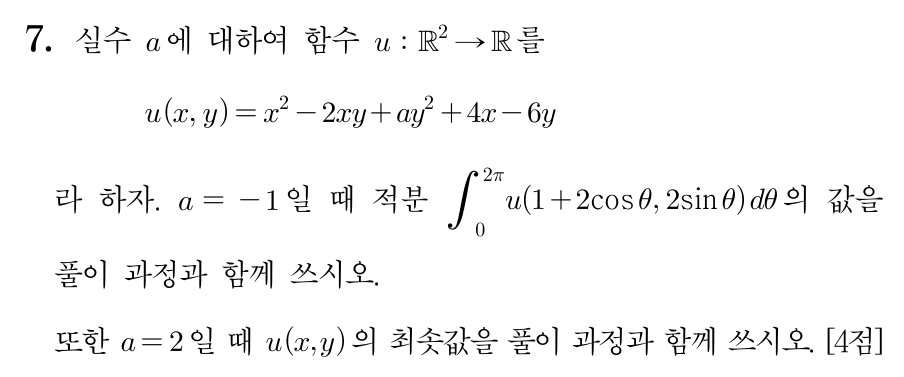
\(a=-1\)일 때 \(\displaystyle \int_{0}^{2\pi}u(1+2\cos\theta,2\sin\theta)\,d\theta=10\pi\). \(a=2\)일 때 \(u(x,y)\)의 최솟값은 \(-5\)이며 \((x,y)=(-1,1)\)에서 달성된다.
출제 의도
삼각함수로 매개화된 점 \((x,y)\)를 함수 \(u(x,y)\)에 대입해 주기적 성질로 적분을 계산하는 능력과, 이차함수의 최소값을 편미분(또는 완전제곱)으로 구하는 능력을 평가한다.
풀이 과정
\(a=-1\)이면 \(u(x,y)=x^2-2xy-y^2+4x-6y\)이다. \(x=1+2\cos\theta,\ y=2\sin\theta\)로 두고 \(\cos\theta=c,\ \sin\theta=s\)라 쓰면
$$ x^2=(1+2c)^2=1+4c+4c^2,\quad y^2=4s^2,\quad xy=(1+2c)(2s)=2s+4cs $$
따라서
$$ \begin{aligned} u(1+2c,2s) &=(1+4c+4c^2)-2(2s+4cs)-4s^2+4(1+2c)-6(2s)\\ &=5+12c+4c^2-16s-8cs-4s^2 \end{aligned} $$
이를 \(0\le \theta\le 2\pi\)에서 적분하면 \(\int_0^{2\pi}c\,d\theta=\int_0^{2\pi}s\,d\theta=\int_0^{2\pi}cs\,d\theta=0\)이고, \(\int_0^{2\pi}c^2\,d\theta=\int_0^{2\pi}s^2\,d\theta=\pi\)이므로
$$ \int_{0}^{2\pi}u(1+2\cos\theta,2\sin\theta)\,d\theta =\int_{0}^{2\pi}\left(5+4c^2-4s^2\right)d\theta =10\pi+4\pi-4\pi =10\pi $$
이제 \(a=2\)일 때 \(u(x,y)=x^2-2xy+2y^2+4x-6y\)의 최소값을 구한다. 편미분하여 임계점을 찾으면
$$ \frac{\partial u}{\partial x}=2x-2y+4=0,\qquad \frac{\partial u}{\partial y}=-2x+4y-6=0 $$
첫 식에서 \(x=y-2\)이고 이를 둘째 식에 대입하면
$$ -2(y-2)+4y-6=0\ \Rightarrow\ 2y-2=0\ \Rightarrow\ y=1,\quad x=-1 $$
이 점에서의 함수값은
$$ u(-1,1)=(-1)^2-2(-1)(1)+2(1)^2+4(-1)-6(1)=1+2+2-4-6=-5 $$
또한 이차형의 행렬 \(\begin{pmatrix}1&-1\\-1&2\end{pmatrix}\)은 \(\det=1>0\), \(\operatorname{tr}=3>0\)이므로 양의 정부호여서 임계점에서 전역 최소값을 갖는다. 따라서 최솟값은 \(-5\)이다.
<풀이가 부정확할 수 있으니 반드시 교차검증 확인 바랍니다.>